|
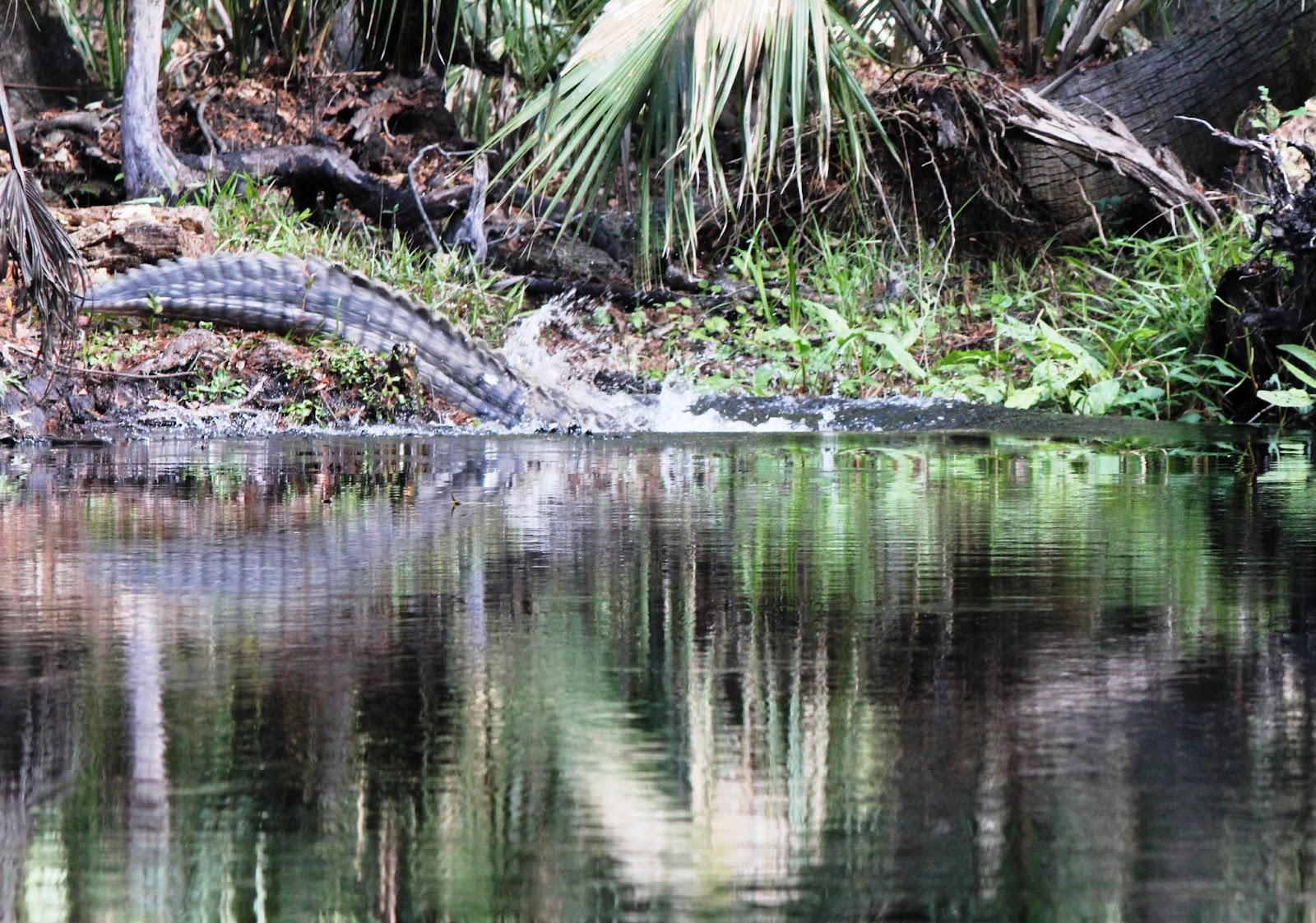
| Big gator makes a run for the Blackwater Creek!!!! |
Today we did scratch another place from our bucket list; Blackwater Creek. It was a good day for gator viewing, as a matter of fact, saw more gators than birds and humans. It was my wife's birthday and I was thinking that nothing would top a bear's or a deer's pic as a birthday present. Greedy, I know, but I had to try. We did not see bears or deer but the big guy in the pic above was not the biggest gator we saw. We saw one even bigger in one of these "What the heck are we doing here" moments but I will go back there later. Took a pic of the bird below on our way to the put in.
 |
| Loggerhead Shrike |
Put In / Take Out: The Put In and Take Out for this trip was a bridge over Blackwater Creek at the Seminole Forest. A permit to enter the forest is needed. I e-mailed two weeks ago and asked for one. Got a phone call from the Forest Service asking some basic information and the dates I planned to be at the creek. A few minutes later an e-mail with a combination for a lock was sent together with some instructions and the rules to use the facilities. The entrance to the road leading to the bridge is at SR46. If you are going West on SR 46 cross the bridge over the Wekiva River, the entrance to the Seminole State Forest will be at your right. There is gate and the combination the Forest Service sends you is for a lock at that gate. Close the gate behind you and drive a little over 2 miles to the bridge over Blackwater Creek area. The put in is after crossing the bridge, near the picnic tables. One car with a trailer was in the area when we arrived. Oh, I forgot, have to pay a fee of $2.00 per person. It is an honor system meaning that you put the money in an envelope and deposit the envelope at the box at the entrance of the forest.
 |
| Put In - Downstream view |
We started our paddle downstream around 9:50AM. My goal was to go all the way down to where Blackwater Creek joins the Wekiva River, maybe go up or down river for a few minutes and then return to the put in. I was hoping to provide my wife the chance to see a bear or a deer from the yak on her birthday. If you did read our recent post from
Silver River you know that we saw a bear at the Ocala National Forest and she was able to shoot a pic at it, which made her very happy that day. Anyways, I cannot think on another place right now with higher chances to see a bear than the Seminole State Forest and Blackwater Creek. Had to try. We did not see any bear or deer but there was not a dull moment on this trip. Keep reading.
 |
| Red Bellied Woodpecker |
 |
| Belted Kingfisher |
The wildlife at the creek was not easy to spot. Blackwater Creek is flanked by trees all the way to the Wekiva River, with maybe a small open section half way downstream from the bridge. There were lots of Red Bellied and Pileated Woodpeckers, Robins, some small song birds, and also some Red Shouldered Hawks. Not too many chances for pics but we kept trying. When we started I warned my wife about the gators. I have read that the Blackwater Creek gators are big and skittish but having kayaking the Ecolockhatchee River we are used to that, or so we thought. A Belted Kingfisher escorted us for the first hour of our trip. It will fly out of the tree cover, stay in a branch long enough for my wife to point the camera at it and then fly away to a farther branch doing that noise they do as mocking the frustrated photographer. That did keep us busy and entertained for a good part of the trip. I was just letting the current to take us downstream making the correctional strokes to keep us on the center of the narrow and twisty waterway. We were so glad I did this. You will see why soon.
 |
| Red Shouldered Hawks |
 |
| Baby Gators!!!!! |
We did not see any gators until after the first hour of the paddle. I was just wondering if the legendary Blackwater Creek gators decided to take the day off when a 4 footer dove into the creek in front of us. Wifey let a little Ahhhh escape when she saw the reptile diving in the water. I reminded her about what we talked at the beginning of the trip and she decided to keep her eyes open. it was a good thing because after that it looked like we were at Gatorland. We could not move for 5 minutes in the creek without hearing a loud splash of a gator making a run into the water. We also saw several little ones, at many different places, making a rapid entry to the creek. I lost count on how many gators we saw at Blackwater Creek today. It was incredible. At every bend, and every stretch there was a gator diving in. Only a few of them decided to be pic friendly and wifey took advantage of that. Those were not too big though. At one stretch we saw a big one and we approached cautiously. It did not sense us until we were about maybe 50 to 60 ft away( I do not really know since am terrible at estimating distances). Once it did, made a dash for the water and wifey caught the whole sequence. After the gator dove into the water we hoped it stayed down on it because there was not enough room for both the reptile and us in the creek. My wife made a comment about it saying that it looked like a dinosaur, and she was right. It did look like one. We were impressed with the size of it. Little we know at the time that we will see another one that would make that one little. Here is the sequence my wife was able to catch...
 |
| The approach... |
 |
| But there it goes...making a run for the water... |
 |
| Splash!!!! |
 |
| ...and gone... |
 |
| Pic friendly Blackwater Creek gator |
After that one the gator encounters became less frequent. Have to say that all the gators we saw were at the north or west bank(our left side) of the creek, where the sun light was hitting directly. This is why what happened next was so unexpected and exciting. We heard the sound of branches and sticks being crushed in front of us but to our right. I thought it was a bear, was hoping for a bear, and kept paddling to get a better look. Wifey had the camera ready when we arrived at the area where the noise was coming from. I did paddle away from that side of the creek to give us, and the supposed bear, a wide berth. The bow of our yak was almost parallel to the noise area when suddenly a huge gray gator head showed up behind a log. Sticks and branches flying all over behind it as the gigantic gator dove into the creek in our direction. As my wife, for some reason I do not understand, put the camera down and grabbed the paddles high in the air, I did try to move us from the path of the diving gator. I saw his head going into the water, and then his body, and asked myself when it was going to finish entering the water. Seemed to me it took forever as we saw the body of the gator going in. I did locate it going up creek. Blackwater Creek is spring fed and the water is clear enough to see the stirred the bottom as it swam. It was impressive. Made me remember the famous movie line from Jaws..."We need a bigger boat". Only thing is that our yak is 13.5ft and that thing was easily as big. We kept going downstream making fun out of each other's reaction. Sadly, no pics from the giant one. It is little consolation to think that he was as scared as we were.
 |
| Otter |
 |
| Blackwater Creek gator |
Spotted otters twice at Blackwater Creek. Wifey did see two out of the creek in the South bank and then one came swimming in front of us some minutes later. Only able to catch the one in the pic above. Made it to the Wekiva River at 12:05. It was relaxing to finally reach a familiar area. Did paddle upstream for 5 minutes when the photographer asked to start our return paddle. Another large gator was working as a doorman at the mouth of the creek. Took us 2 hours and 30 minutes to go back to the bridge at the Seminole State Forest. Made one short stop to drain the water inside the yak. Not too many gators to see in the upstream paddle. Looks like we scared them all going downstream. A couple of them were at the exactly same spot we saw them the first time.
 |
| Wekiva River gator |
My wife read the post and reminded me I did not include a
Did You Know What? for this one. The star of our
Did You Know That? of this post is a little bird that is meaner than its looks: The Loggerhead Shrike.
 |
| Loggerhead Shrike |
Did You Know That? The Loggerhead Shrike is a passerine(perching) bird. It is the only member of the shrike family endemic to North America. The bird has a large hooked bill; the head and back are grey and the underparts white. The wings and tail are black, with white patches on the wings and white on the outer tail feather. The black face mask extends over the bill. The bird breeds in semi-open areas in Southern Ontario, Quebec and the Canadian prairie provinces, south to Mexico. It nests in dense trees and shrubs. The female lays 4 to 8 eggs in a bulky cup made of twigs and grass. There is an increase in average clutch size as latitude increases. The shrike is a permanent resident in the southern part of the range; northern birds migrate further south. The bird waits on a perch with open lines of sight and swoops down to capture prey. Its food is large insects and lizards. Known in many parts as the "Butcher Bird," it impales its prey on thorns or barbed wire before eating it, because it does not have the talons of the larger birds of prey. "Loggerhead" refers to the relatively large head as compared to the rest of the body.
Here are a few more pics of what we saw today...
 |
| Cardinal |
 |
| Eastern Phoebe |
 |
| Red Bellied Woodpecker |
 |
| Red Bellied Woodpecker |
 |
| Red Shouldered Hawk |
 |
| Diving little gator |
 |
| Babies |
 |
| Gator |
 |
| Juvenile Little Blue Heron |
 |
| Hooded Merganser(female) |
 |
| Gator |
 |
| Limpkin |
 |
| Gator |
 |
| Robin |
 |
| Tiny gator. That one will not last long. All his siblings made it to the water. |
 |
| Blackwater Creek scene |
And that is it for this one. Here is the link to the Photobucket album Blackwater Creek, where all the pics of the trip are posted. Thanks for reading and Merry Christmas to all. Have a wonderful day.
 |
| Put In / Take Out at Blackwater Creek!!!!!!!!!! |